
Architecture
PocketPaw is built on an event-driven message bus architecture. This design decouples channels from agent backends, making it easy to add new channels and swap backends without touching the core pipeline.
High-Level Overview
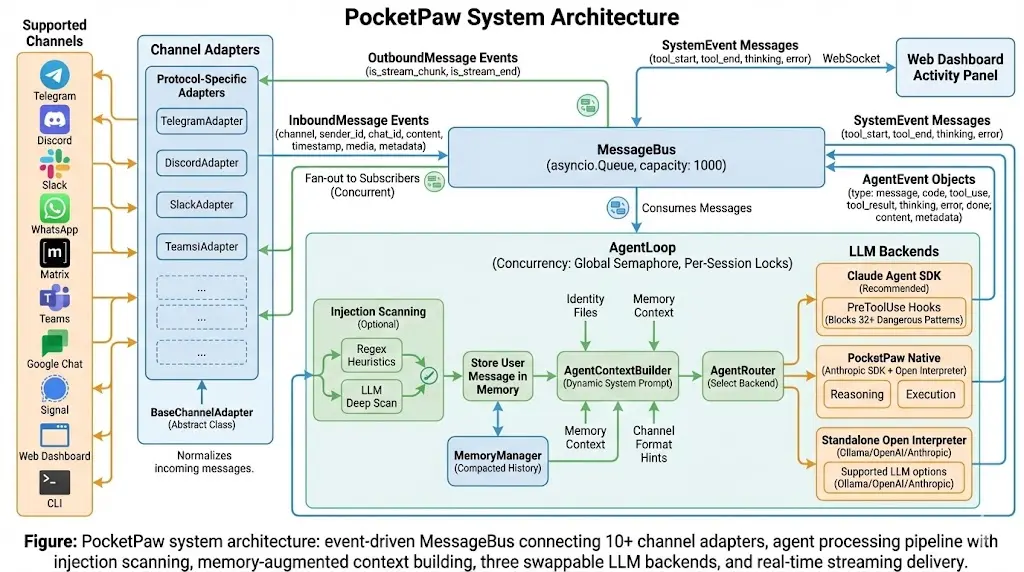
Processing Pipeline
When a user sends a message from any channel, it follows this path:
Channel Adapter receives message
The channel-specific adapter (Telegram, Discord, etc.) translates the platform’s message format into a standardized InboundMessage event and publishes it to the message bus.
AgentLoop consumes the message
The AgentLoop subscribes to InboundMessage events. It loads the session context, builds the system prompt with memory and identity, and prepares the request for the agent backend.
AgentRouter selects the backend
Based on the agent_backend setting, the router delegates to one of three backends: Claude Agent SDK, PocketPaw Native, or Open Interpreter.
Backend processes and streams
The selected backend processes the message, executes any tool calls, and yields a stream of response chunks back to the AgentLoop.
AgentLoop publishes responses
Response chunks are published as OutboundMessage events (with is_stream_chunk=True for intermediate chunks and is_stream_end=True for the final chunk). Tool executions emit SystemEvent events.
Channel Adapters deliver
Each channel adapter subscribed to OutboundMessage events translates and delivers the response in the appropriate format for its platform (e.g., Telegram messages, Discord embeds, Slack thread replies).
Key Design Principles
Protocol-Oriented
Core interfaces are Python Protocol classes, enabling swappable implementations:
AgentProtocol— Agent backend interfaceToolProtocol— Tool interface with schema exportMemoryStoreProtocol— Memory backend interfaceBaseChannelAdapter— Channel adapter interface
Async Everywhere
All agent, bus, memory, and tool interfaces are async. PocketPaw uses asyncio throughout, with pytest-asyncio for testing.
Lazy Imports
Agent backends and optional dependencies are imported lazily inside their initialization methods. This avoids loading unused dependencies and keeps startup time fast.
Event Types
The message bus uses three event types:
| Event | Purpose | Consumers |
|---|---|---|
InboundMessage | User input from any channel | AgentLoop |
OutboundMessage | Agent responses back to channels | Channel adapters, WebSocket |
SystemEvent | Internal events (tool_start, tool_result, thinking, error) | Web dashboard Activity panel |
Subsystem Interactions
The AgentLoop is the central coordinator:
- Security — Guardian AI and injection scanner check every message before processing
- Memory — Context builder assembles session history, long-term facts, and semantic search results
- Tools — The tool registry provides available tools filtered by the policy system
- Backends — The router delegates to the selected agent backend